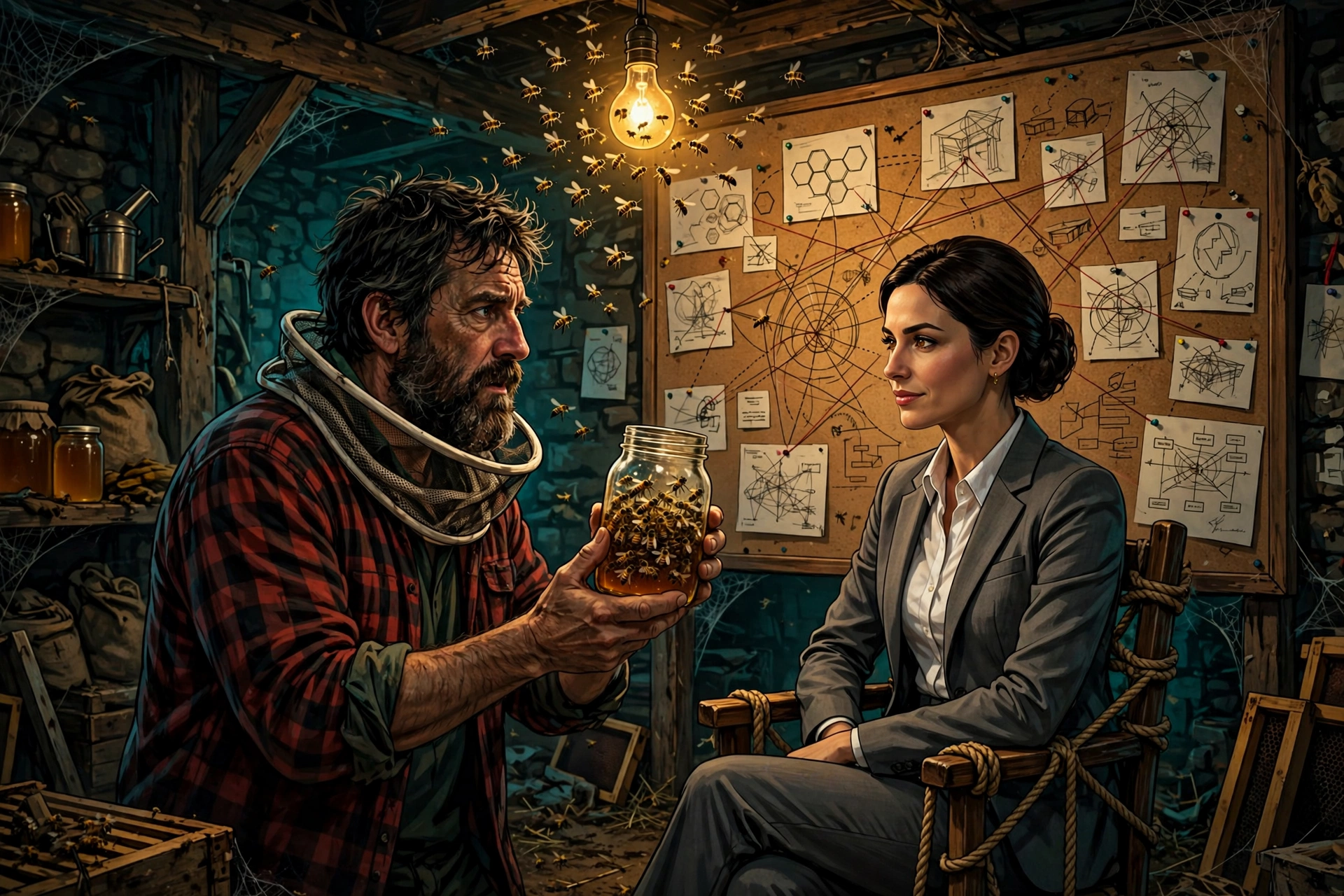
Bugonia has one of the most talked-about endings of recent years, and it only makes sense once you realise the film has been hiding its biggest clue in plain sight. Yorgos Lanthimos’s dark sci-fi comedy stars Emma Stone as a biotech CEO and Jesse Plemons as the conspiracy theorist who kidnaps her, convinced she is an alien. Here is our complete Bugonia ending explained guide: cast, story, the alien twist, what the ending means, reviews and where to watch.
Bugonia Cast
- Emma Stone as Michelle Fuller, CEO of the biotech company Auxolith
- Jesse Plemons as Teddy Gatz, a beekeeper and conspiracy theorist
- Aidan Bisbin as Don, Teddy’s cousin, who helps with the kidnapping
- Alicia Silverstone as Teddy’s mother
Bugonia is directed by Yorgos Lanthimos and written by Will Tracy, adapted from the 2003 South Korean film Save the Green Planet!. It is Stone’s fourth collaboration with Lanthimos, after The Favourite, Poor Things and Kinds of Kindness. The score is by Jerskin Fendrix, and the cinematography by Robbie Ryan gives the film its tight, unsettling look.
Bugonia Story
Teddy Gatz lives in a secluded farmhouse with his cousin Don, keeping bees and nursing a grief that has curdled into obsession. His mother is seriously ill, the honeybees are dying, and Teddy has found an explanation that ties it all together: Michelle Fuller, the CEO of the pharmaceutical company where he used to work, is an alien from the planet Andromeda, sent to kill the bees and enslave humanity.
Teddy and Don kidnap Michelle and hold her in their basement, interrogating her and torturing her to force a confession. Michelle, calm and ruthlessly competent, treats the situation like a hostile negotiation, using her corporate communication skills to stall, divide her captors and look for an escape. The film keeps you guessing for most of its runtime. Is Teddy a dangerous fantasist, or has he stumbled onto something real? The evidence keeps pointing both ways, and Lanthimos makes sure the person telling you the truth is the least trustworthy person in the room.
Bugonia Ending Explained
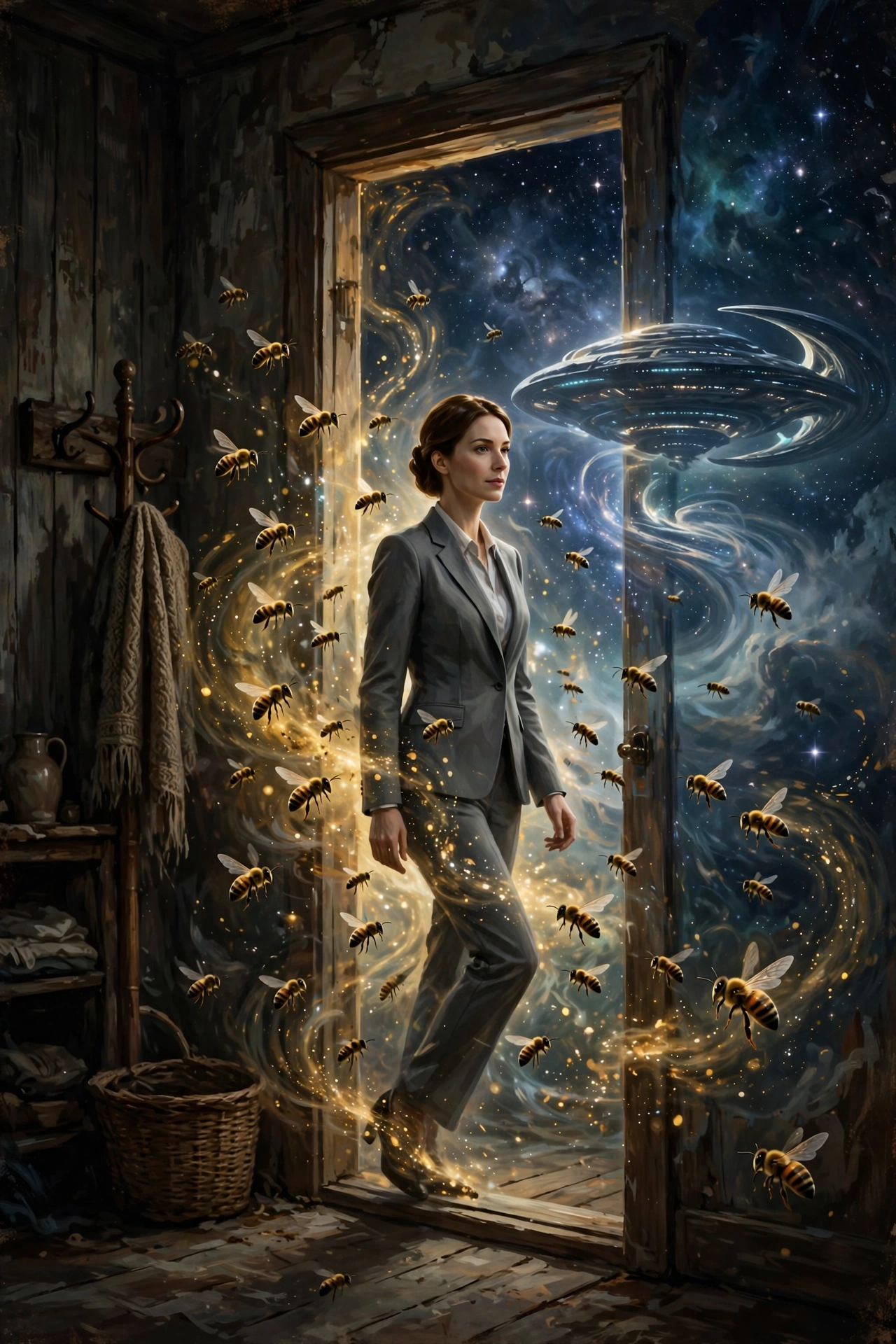
Warning: full spoilers for the ending of Bugonia follow.
The twist is that Teddy was right. Almost entirely right. Michelle Fuller really is an alien, a royal member of the Andromedan race, and she really has been living on Earth in secret. Even the detail Teddy seemed maddest about, that her hair is a communication device, turns out to be true. What Teddy got wrong was her purpose. The Andromedans are not on Earth to kill the bees or harm humanity. They came to test whether human beings can get past their selfish, violent nature and live in harmony.
The ending turns on a grim irony. Michelle tricks Teddy into detonating the bomb strapped around his waist, killing him, and she escapes in an ambulance. But she returns to the same closet in Teddy’s house, the doorway the Andromedons use to travel, and teleports back to her mothership. There, she and her fellow Andromedons review what they have seen. Teddy tortured and killed people who were not aliens at all, and he proved, in their eyes, that humanity cannot change. The council decides the human experiment has failed.
Michelle triggers a dome that encases the planet and kills every human being on Earth. Animals and plants are left untouched, and the film closes with a montage of dead humans in schools, at weddings and in streets, set against nature thriving again. The bees, the creatures Teddy was trying to save, survive. Humanity does not.
What the Bugonia Ending Means
The ending is a trap for the audience as much as for Teddy. Being right about one extraordinary fact does not make Teddy rational, and it does not excuse what he did. He reached a correct conclusion through paranoia, violence and confirmation bias, and the film refuses to let that method off the hook. He can be right about Michelle’s species and still be disastrously wrong about how to treat other people.
There is also a darker joke at the heart of the film. Teddy spent the whole story warning that the aliens would destroy humanity, and in the end it was his own cruelty that convinced the aliens to do exactly that. The Andromedons came as observers. Humanity supplied the verdict itself.
On a second level, Bugonia is Lanthimos’s attack on corporate power and environmental destruction. The opening image, dying worker bees delivering pollen to a thriving queen who is slowly killing her own colony, is the film in miniature: a system that consumes itself. Michelle’s company, her polished corporate language and her total control of every room she enters make her the perfect disguise for an alien, because a biotech CEO already behaves like someone from another world.
What Does Bugonia Mean?
“Bugonia” comes from an ancient Mediterranean myth, described by the Roman poet Virgil, in which bees are born from the carcass of a sacrificed ox. Death produces new life. The title is the film’s thesis in one word: the destruction of one thing makes room for another. In the final minutes, the death of humanity lets nature, and the bees, thrive again.
Bugonia Review: Is It Worth Watching?
Bugonia is divisive by design, and that is exactly what has kept it in the conversation through awards season, with four Oscar nominations to its name. Critics split on the ending, with some calling it predictable and others calling it brilliant, but almost everyone agrees on the two central performances. Plemons never plays Teddy as a fool, which is essential, because the film only works if you can believe a smart man could talk himself into this. Stone is superb as Michelle, playing her like a highly capable executive who knows how to perform concern, control a conversation and steer people toward the outcome she wants, all while hiding something genuinely inhuman.
The film is dark, funny, gory and deeply uncomfortable in places, and it is not a casual watch. But if you like Lanthimos’s previous work, or you enjoy a thriller that makes you argue about it afterwards, Bugonia is one of the most rewarding films of its year. Go in knowing as little as possible, and let the ending land on you the way it is meant to.
Bugonia vs Save the Green Planet
Bugonia is a remake of Jang Joon-hwan’s 2003 South Korean film Save the Green Planet!, and it keeps the original’s structure and ending almost intact. The biggest change is tone: Lanthimos and Tracy make the satire sharper and the corporate setting more central, turning the alien CEO into a figure of modern power rather than a generic authority. Fans of the original will recognise every major beat. Newcomers do not need to have seen it.
Where to Watch Bugonia
Bugonia is streaming on Netflix. It played in cinemas first, premiering at the Venice Film Festival before its theatrical run, and it is now available to stream at home. For more twist-heavy viewing, see our guides to Klara and the Sun (2026) and Frankenstein (2026), and our latest movies 2026 reviews hub.
Bugonia FAQs
Is Michelle really an alien in Bugonia?
Yes. The ending confirms Michelle Fuller is a royal Andromedan alien, and Teddy was right about her species, her hair being a communication device, and her secret life on Earth.
What happens at the end of Bugonia?
Teddy dies when his bomb vest detonates, Michelle returns to her mothership, and the Andromedans decide humanity has failed its test. A dome encases Earth and kills all humans, while animals and plants survive.
Is Bugonia based on a true story?
No. Bugonia is a remake of the 2003 South Korean film Save the Green Planet!, and its title comes from an ancient myth about bees being born from a sacrificed ox.
Who directed Bugonia?
Yorgos Lanthimos directed Bugonia, from a screenplay by Will Tracy. It is his fourth film with Emma Stone.
Where can I watch Bugonia?
Bugonia is streaming on Netflix after its theatrical run.
Is Bugonia worth watching?
Yes, if you like dark, unsettling thrillers. The two lead performances are widely praised, and the ending is one of the most debated of recent years, even though some viewers find it predictable.