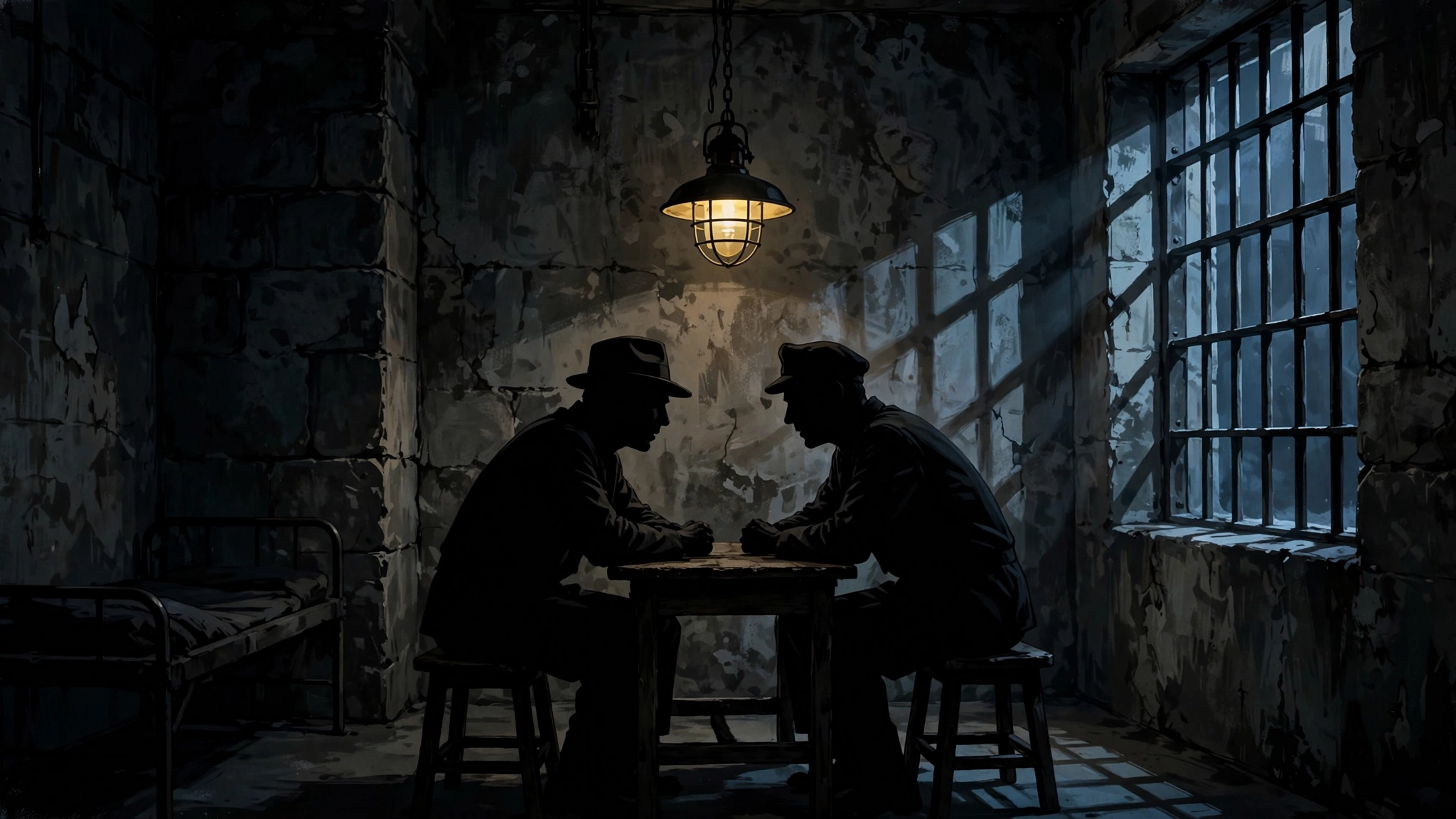
Nuremberg (2026) opened in US cinemas on 7 November 2026, and it is one of the most talked-about historical dramas of the year. Russell Crowe plays Hermann Göring, the former head of the Luftwaffe and one of Adolf Hitler’s most powerful lieutenants, while Rami Malek plays the US Army psychiatrist sent to decide whether Göring is fit to stand trial. It is a film about the battle that happened before the courtroom battle: a psychological duel inside a prison cell, between a doctor trying to understand evil and a prisoner trying to manipulate him.
Nuremberg Release Date and Where to Watch
Nuremberg released in US cinemas on Friday, 7 November 2026, through Sony Pictures Classics, arriving just ahead of the 80th anniversary of the Nuremberg Trials. The film had its world premiere at the Toronto International Film Festival, where Crowe’s performance drew ovations. A streaming release is expected to follow the theatrical run. We will update this section when the digital and streaming dates are confirmed.
Nuremberg Cast: Russell Crowe, Rami Malek and Michael Shannon
The film’s ensemble is stacked with award-winning and award-nominated talent, which is exactly what a story like this needs. The three leads carry almost the entire film between them.
- Russell Crowe as Hermann Göring, the former Reichsmarschall awaiting trial
- Rami Malek as Douglas Kelley, the US Army psychiatrist tasked with evaluating the Nazi prisoners
- Michael Shannon as Robert H. Jackson, the US chief prosecutor
- Richard E. Grant in a key supporting role
- Leo Woodall as Howard Triest, the young translator, speaking German in the role
- John Slattery, Colin Hanks, Mark O’Brien, Lydia Peckham, Wrenn Schmidt, Lotte Verbeek and Andreas Pietschmann in supporting roles
Crowe’s preparation for the role became a story of its own. He learned German for the part and shaved for the first time in five years to capture Göring’s appearance. Malek plays Kelley as a methodical, observant doctor, a man trying to stay clinical while sitting across the table from one of history’s greatest criminals.
Nuremberg True Story: What Really Happened?
Yes, Nuremberg is based on a true story. After the Second World War ended in 1945, the Allies put the surviving senior leaders of the Nazi regime on trial in the German city of Nuremberg. It was the first time in history that international law had been used to prosecute war crimes on this scale, and the trials ran from November 1945 to October 1946.
Before the trials could begin, the Allies had to prove the defendants were mentally fit to stand trial. That job fell to US Army psychiatrist Douglas Kelley, who was ordered to evaluate the prisoners. His primary subject was Hermann Göring, Hitler’s right-hand man, a man the world saw as a monster, but who Kelley found to be intelligent, charming and deeply manipulative.
The film is based on Jack El-Hai’s acclaimed 2013 nonfiction book The Nazi and the Psychiatrist, which reconstructed Kelley’s interviews and his growing unease about what he was discovering. The book, and the film, ask the same uncomfortable question: what do you do when the man behind some of history’s worst crimes turns out to be rational, likeable and fully aware of what he did?
Nuremberg Story: The Psychiatrist vs Göring
Rather than staging another courtroom procedural, the film shifts the lens behind prison walls, where the battle was not legal but psychological. Kelley meets Göring in his cell, day after day, administering tests and trying to work out whether the man in front of him understands what he is accused of.

Göring, played by Crowe as calculating and disturbingly self-assured, treats the sessions as a game. He flatters Kelley, tests his limits and tries to turn the psychiatrist into a sympathetic listener. Kelley slowly realises that the interviews are changing him.
Around them, the trial is being built. Michael Shannon’s Robert H. Jackson, the US chief prosecutor, must make sure the Nazi regime answers for the horrors of the Holocaust in a courtroom the whole world is watching.
Nuremberg Ending Explained (Documented History)
The film follows a true story, so its ending follows the historical record. The Nuremberg Trials ended in October 1946 with verdicts that shaped international law. Hermann Göring was found guilty on all counts, including war crimes and crimes against humanity, and sentenced to death by hanging.
Göring never faced the gallows. On the night before his scheduled execution, 15 October 1946, he died by suicide in his cell, taking a cyanide capsule he had managed to hide. It was his final act of control, denying the court the execution it had ordered. The film builds toward this outcome, and knowing the history in advance does not spoil it: the drama is in watching Kelley realise, too late, just how completely Göring had been playing him.
Douglas Kelley’s own story did not end at Nuremberg either. He returned to the United States and continued his psychiatric career, but the interviews stayed with him for the rest of his life. The film leaves the audience with the same question Kelley carried home: if evil can look reasonable, charming and intelligent, how do you recognise it before it is too late?
The Book Behind the Film: The Nazi and the Psychiatrist
Nuremberg is written and directed by James Vanderbilt, best known for writing Zodiac and Scream, in his feature directorial debut. Vanderbilt adapted Jack El-Hai’s 2013 book The Nazi and the Psychiatrist, which drew on Kelley’s own notes and test records to reconstruct the interviews.
The book’s strength is that it never lets the reader settle. Kelley is not a hero in the simple sense, and Göring is not a cartoon villain. The film keeps that ambiguity, which is why it works better as a psychological thriller than as a history lesson.
Nuremberg Reviews: What Critics Are Saying
Nuremberg premiered at the Toronto International Film Festival, where Crowe’s performance drew ovations from the audience, and early reactions have focused on the two central performances. Critics have praised Crowe for refusing to soften Göring, playing him as intelligent and magnetic rather than as a ranting caricature, and Malek for the quiet intensity he brings to Kelley.
The film has also been noted for its restraint. Vanderbilt avoids battlefield spectacle and keeps the camera in small rooms, on faces, on the space between two men at a table. It is a chamber piece about power, not a war epic, and its tension comes from conversation, not combat.
Is Nuremberg Based on a True Story?
Yes. Nuremberg is based on the true story of the Nuremberg Trials of 1945 to 1946 and on the real interviews between US Army psychiatrist Douglas Kelley and Hermann Göring, as documented in Jack El-Hai’s book The Nazi and the Psychiatrist. The central characters were real people, the trials happened, and the verdicts and Göring’s death are documented history. Some conversations and smaller scenes are dramatised, as they are in any film based on real events, but the spine of the story is factual.
Nuremberg (2026) FAQs
When was Nuremberg released?
Nuremberg released in US cinemas on 7 November 2026, ahead of the anniversary of the Nuremberg Trials.
Who plays Göring in Nuremberg?
Russell Crowe plays Hermann Göring, with Rami Malek as psychiatrist Douglas Kelley and Michael Shannon as chief prosecutor Robert H. Jackson.
Is Nuremberg based on a true story?
Yes. It is based on the real Nuremberg Trials and on Jack El-Hai’s book The Nazi and the Psychiatrist, about Kelley’s interviews with Göring.
What happens at the end of Nuremberg?
Following the historical record, Göring is found guilty and sentenced to death, but dies by suicide in his cell the night before his execution, on 15 October 1946.
Where can I watch Nuremberg?
In cinemas now. A streaming release will follow the theatrical run, with the date still to be confirmed.
For more true-story dramas, see our guides to Being Heumann and Jimmy, and our Christy review.